
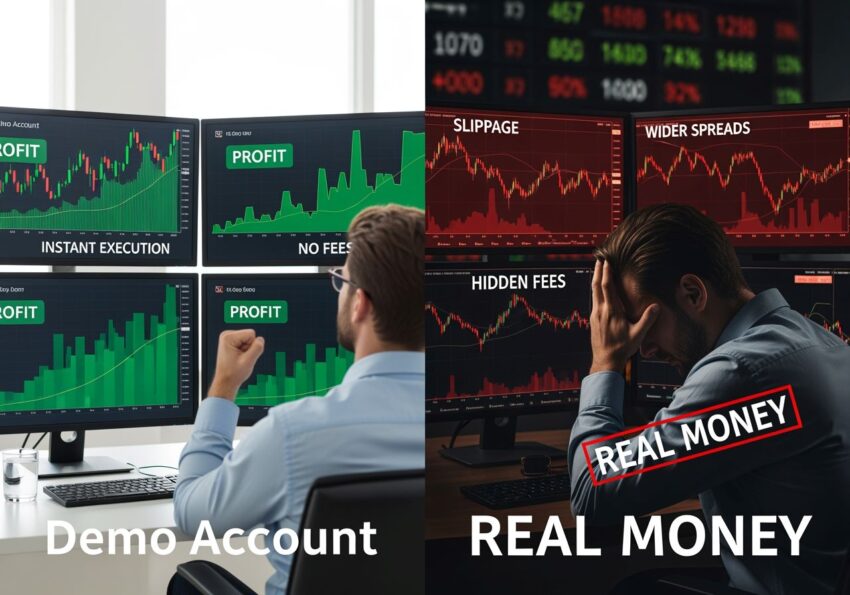
Many traders experience a harsh reality check when transitioning from demo accounts to live trading. A string of successful virtual trades can create dangerous overconfidence, leading new traders to believe they’ve mastered the markets. However, demo success rarely translates directly to live trading profitability, and this misconception costs countless traders their hard-earned capital.
The fundamental differences between virtual and real money trading extend far beyond simple funding mechanisms. Demo accounts operate in an idealized environment where emotional pressure is absent, execution is perfect, and costs are often minimized or eliminated entirely. Live trading introduces genuine financial risk, psychological stress, slippage, wider spreads, and hidden fees that can quickly erode profits. Understanding these critical distinctions is essential for developing realistic expectations and proper risk management strategies before risking real capital in volatile financial markets.
Core Differences in Funding and Risk
The most fundamental distinction between demo and live trading lies in the nature of capital at risk. Virtual funds create an artificial safety net that completely alters trading psychology and decision-making processes. This disparity extends beyond simple monetary differences to encompass emotional responses, risk tolerance, and strategic thinking patterns that only emerge under genuine financial pressure.
Demo accounts operate with simulated profit and loss calculations that carry zero real-world consequences, while live accounts involve actual financial gains and losses that directly impact traders’ wealth and emotional state. The psychological weight of potential losses fundamentally changes how traders approach position sizing, exit strategies, and market analysis when real money is involved.
| Aspect | Demo Account | Live Account | Impact on Trading |
|---|---|---|---|
| Capital Source | Virtual funds | Real deposited money | Emotional attachment varies dramatically |
| Loss Consequences | No financial impact | Direct wealth reduction | Risk tolerance completely different |
| Profit Realization | Simulated gains only | Withdrawable profits | Motivation and pressure levels shift |
| Stress Response | Minimal emotional impact | High stress and anxiety | Decision quality often deteriorates |
| Account Replenishment | Instant reset available | Requires new deposits | Forces realistic capital preservation |
Virtual Funds Illusion
Demo accounts create a dangerous illusion of competence by removing the emotional component that drives most trading failures. Traders often develop false confidence from consistent demo profits, believing their strategies are sound when they’ve simply avoided the psychological pressures that plague live trading. This risk-free environment encourages aggressive position sizing and casual attitude toward losses that would be devastating with real money.
The virtual nature of demo funds allows traders to take risks they would never consider with their actual savings, creating unrealistic performance expectations. When traders transition to live accounts, they’re often shocked by their sudden inability to replicate demo results, not realizing that emotional control was never tested in their virtual environment.
Real Capital Consequences
Live trading introduces genuine financial consequences that fundamentally alter decision-making processes and risk assessment. The knowledge that losses directly impact personal wealth creates stress responses that can override logical analysis and disciplined strategy execution. Even small losses can trigger emotional reactions that compound into larger mistakes when real money is involved.
The weight of actual financial responsibility forces traders to confront their true risk tolerance and often reveals that their demo trading approach was unrealistic. Real capital consequences create urgency and pressure that can lead to premature trade exits, revenge trading, and abandonment of proven strategies during temporary drawdowns.
Execution and Slippage Disparities
Demo platforms typically provide idealized execution conditions that rarely reflect live market realities. While virtual trades execute instantly at displayed prices, live trading involves real market dynamics where liquidity constraints, network delays, and market volatility create execution challenges that can significantly impact profitability. These disparities often come as shocking surprises to traders transitioning from smooth demo experiences.
The artificial perfection of demo execution creates unrealistic expectations about trade entry and exit points. Live markets introduce slippage, requotes, and execution delays that can turn profitable demo strategies into losing propositions when real money is involved, particularly during high-volatility periods or major news events.
Why Demo Feels Too Smooth
Demo platforms are designed to provide frictionless trading experiences that showcase broker capabilities without reflecting real market constraints. Understanding these artificial advantages helps traders develop more realistic expectations for live trading performance.
- Instant order execution regardless of market volatility or liquidity conditions
- No slippage on market orders even during major news events or gap openings
- Perfect price fills without consideration for bid-ask spread dynamics
- Unlimited liquidity assumptions that ignore real market depth limitations
- No network latency or connection issues that commonly affect live platforms
- Ideal stop-loss and take-profit execution without slippage or gaps
Spreads, Costs and Fees Comparison
Demo accounts often present artificially favorable cost structures that significantly underestimate the true expense of live trading. Many brokers reduce or eliminate spreads, commissions, and overnight financing charges on demo accounts to make trading appear more profitable than reality. These hidden costs can dramatically impact strategy viability when transitioning to live markets.
The accumulation of real trading costs often transforms marginally profitable demo strategies into losing propositions. Understanding the true cost structure is essential for realistic performance expectations and proper strategy evaluation before risking real capital.
| Cost Type | Demo | Live | Trader Impact |
|---|---|---|---|
| Spreads | Often reduced or ideal | Variable market spreads | Higher entry costs reduce profitability |
| Commissions | Usually waived | Per-lot or percentage fees | Direct profit erosion on each trade |
| Swap Rates | Minimal or ignored | Daily overnight charges | Compounds costs for position trades |
| Financing Costs | Not applied | Interest on leveraged positions | Affects long-term holding strategies |
| Platform Fees | Free access | Monthly subscription costs | Fixed overhead regardless of activity |
| Data Fees | Included at no cost | Premium data subscriptions | Additional monthly expenses |
Hidden Cost Accumulation
Live trading costs accumulate rapidly and can transform seemingly profitable strategies into break-even or losing propositions. Spreads alone can consume 20-50% of small profit targets, while overnight financing charges steadily erode longer-term positions. High-frequency trading strategies that appear profitable in demo environments often fail due to commission structures that weren’t factored into demo results.
The psychological impact of constant cost deductions can also affect trading behavior, causing traders to hold losing positions longer to avoid paying exit costs or rushing profitable trades to minimize exposure to ongoing fees. Understanding true cost structures allows for realistic profit targeting and appropriate strategy selection.
Liquidity Limitations
Demo accounts typically assume unlimited liquidity at displayed prices, ignoring the market depth constraints that affect large position executions in live markets. Real markets have finite liquidity at each price level, particularly for exotic currency pairs or during off-hours trading sessions when participation is limited.
Large position sizes that execute perfectly in demo environments may face partial fills or significant slippage in live markets where insufficient counterparty interest exists at desired price levels. This liquidity reality forces traders to reconsider position sizing strategies and execution timing for optimal results.
Psychological and Emotional Factors
The psychological gulf between demo and live trading represents perhaps the most significant challenge facing new traders. Demo trading eliminates the emotional stakes that drive most trading failures, creating a false sense of competence that rarely survives contact with real market pressures. The absence of genuine financial risk allows traders to remain calm and objective in situations that would trigger panic and poor decision-making with real money involved.
Live trading introduces fear, greed, hope, and desperation – emotions that can override logical analysis and disciplined execution. Traders often discover that strategies which seemed robust in demo environments crumble under the psychological pressure of actual financial loss. The emotional component of trading cannot be fully understood or prepared for without genuine skin in the game.
Overconfidence from demo success often leads to inadequate preparation for the psychological challenges of live trading. Traders may skip essential education about emotional control, position sizing, and risk management, believing their virtual profits demonstrate market mastery when they’ve simply avoided the mental obstacles that destroy most trading careers.
- Demo trading lacks genuine emotional stakes, preventing development of psychological resilience needed for live markets
- Fear of real losses can paralyze decision-making and prevent execution of otherwise sound trading plans
- Greed amplifies during live trading when real profits are possible, leading to overleveraging and excessive risk-taking
- Hope causes traders to hold losing positions longer with real money, violating stop-loss discipline maintained in demo accounts
- Revenge trading becomes more tempting when actual financial losses create emotional need for immediate recovery
- Stress responses can impair cognitive function and analytical abilities during critical market moments
- Social pressure increases when trading real money that affects family finances or personal financial goals
Building Real Discipline
Developing genuine trading discipline requires creating artificial pressure during demo trading to simulate live market emotions. Traders can attach real consequences to virtual losses by donating money to disliked charities for demo mistakes or treating demo capital as if it represents actual savings. Practicing meditation, stress management, and emotional regulation techniques during demo trading helps prepare for live market pressures.
Maintaining detailed trading journals that track emotional states alongside technical analysis helps identify patterns between psychological condition and trading performance. Building systematic approaches to position sizing, entry criteria, and exit rules during demo trading creates frameworks that can survive emotional pressure when real money is involved.
Risk Management: Practice vs Reality
Demo environments typically encourage relaxed risk management practices since virtual losses carry no consequences, leading to poor habits that prove devastating when applied to real capital. Traders often ignore position sizing rules, skip stop-loss orders, or risk excessive percentages of their demo accounts without consideration for capital preservation principles that are essential for long-term live trading success.
The transition to live trading demands strict risk management protocols where position sizing becomes critical for survival during inevitable losing streaks. Real money forces traders to confront the mathematical reality that large losses require exponentially larger gains for recovery, making capital preservation the primary objective rather than profit maximization.
Common Demo Risk Errors
Demo trading often enables careless risk management practices that would quickly destroy real trading accounts. Recognizing these common mistakes helps traders develop proper discipline before transitioning to live markets.
- Risking 10-20% or more of account capital per trade due to absence of real loss consequences
- Trading without stop-loss orders since demo losses don’t create genuine financial pain or urgency
- Ignoring correlation risks by opening multiple positions in related markets simultaneously without consideration
- Overleveraging positions beyond reasonable risk tolerance levels that would be acceptable with real money
- Failing to plan exit strategies or profit-taking levels before entering trades due to virtual consequence absence
Live Risk Essentials
Successful live trading requires implementation of strict risk management rules that limit potential losses to levels that won’t significantly impact overall financial well-being. The standard recommendation of risking only 1-2% of account capital per trade ensures that even extended losing streaks won’t destroy trading careers or create unbearable emotional pressure that leads to poor decision-making.
Position sizing calculations must account for volatility levels, stop-loss distances, and correlation factors that affect overall portfolio risk exposure. Developing systematic approaches to these calculations during demo trading creates habits that become automatic when emotional pressure increases during live trading situations.
Market Conditions and Predictability
Demo platforms often present sanitized market conditions that underestimate the chaos and unpredictability of live financial markets during volatile periods. Virtual environments may smooth over extreme price movements, gaps, or liquidity crunches that regularly occur during major news events or market stress periods. These idealized conditions create unrealistic expectations about strategy reliability and market behavior consistency.
Live markets frequently experience sudden volatility spikes, unexpected news reactions, and technical breakdowns that can invalidate carefully planned trades within seconds. Demo accounts rarely simulate these chaotic conditions adequately, leaving traders unprepared for the reality of rapid market reversals and unpredictable price action that characterizes real financial markets.
| Condition | Demo Simulation | Live Reality |
|---|---|---|
| Price Gaps | Minimal or smoothed over | Frequent during news and opens |
| Volatility Spikes | Moderated for smooth experience | Extreme and sudden movements |
| News Reactions | Predictable price responses | Unpredictable and chaotic |
| Market Freezes | Continuous trading assumed | Trading halts during crises |
| Flash Crashes | Rarely simulated accurately | Sudden liquidity evaporation |
Adapting to Unpredictability
Live market unpredictability requires flexible trading approaches that can adapt to rapidly changing conditions without abandoning core risk management principles. Successful traders develop contingency plans for various market scenarios, including strategies for handling gaps, volatility spikes, and unexpected news events that can invalidate original trade assumptions within minutes.
The key to managing unpredictable market conditions lies in accepting uncertainty as a fundamental characteristic of financial markets rather than treating it as an exception to normal behavior. This mindset shift helps traders remain calm during chaotic periods and avoid panic decisions that typically result from expecting markets to behave according to predictable patterns.
Developing awareness of economic calendar events, central bank meetings, and potential market-moving announcements helps traders anticipate periods of increased volatility and adjust position sizes or trading strategies accordingly. However, even with careful preparation, markets often react in unexpected ways that require immediate adaptation and flexible response strategies.
Account Features and Restrictions
Demo and live accounts often differ significantly in terms of available features, trading restrictions, and platform capabilities that can affect strategy implementation and performance measurement. These disparities extend beyond simple funding differences to encompass leverage limitations, minimum position sizes, available instruments, and account maintenance requirements that impact real-world trading effectiveness.
Understanding these operational differences helps traders prepare for potential constraints they may encounter when transitioning to live trading environments. Features that seemed readily available in demo accounts may require additional fees, account minimums, or qualification criteria when using real money.
| Feature | Demo | Live | Notes |
|---|---|---|---|
| Maximum Leverage | Often 1:500 or higher | Regulated limits apply | ESMA limits EU retail to 1:30 |
| Account Expiration | 30-90 days typical | Permanent when active | Demo resets lose history |
| Minimum Position Size | Micro-lots allowed | Broker-dependent minimums | May require standard lots |
| Available Instruments | Full range typically | Limited by account type | Exotic pairs may be restricted |
| Trading Hours | 24/5 access assumed | Market-specific limitations | Holidays affect availability |
| Withdrawal Rights | No real withdrawals possible | Subject to verification | KYC requirements mandatory |
| Customer Support | Limited assistance | Priority support access | Account managers available |
| Educational Resources | Basic materials only | Premium content access | Research and analysis included |
Leverage and Position Limits
Demo accounts frequently offer leverage ratios that exceed regulatory limits imposed on live retail trading accounts, creating unrealistic expectations about available purchasing power. European regulations cap retail forex leverage at 1:30, while demo accounts may advertise 1:500 leverage that isn’t available to real account holders under current regulatory frameworks.
Position size limits may also differ between demo and live environments, with some brokers requiring minimum standard lot sizes for live accounts while allowing micro-lot trading in demo environments. These restrictions can force strategy modifications that weren’t necessary during demo testing phases.
Bonus and Withdrawal Access
Demo accounts obviously cannot provide real withdrawal capabilities, preventing traders from experiencing the practical aspects of profit realization and cash management that are integral to successful trading operations. The inability to withdraw funds eliminates important psychological milestones and practical considerations about liquidity management that affect real trading decisions.
Live accounts introduce withdrawal procedures, verification requirements, and processing delays that can impact trading psychology and cash flow planning. Understanding these practical aspects helps traders develop realistic expectations about profit realization and capital management processes.
When to Switch: Transition Strategies
The transition from demo to live trading requires careful planning and systematic preparation that goes beyond simply opening a funded account. Successful transitions typically involve completing extensive demo testing, developing proven strategies, and building emotional discipline before risking real capital. The timing of this switch often determines long-term trading success or failure.
Most successful traders recommend completing at least 50-75 demo trades across various market conditions before considering live trading, ensuring that strategies work consistently across different volatility environments and timeframes. This preparation period should include detailed performance analysis, risk management testing, and emotional preparation for the psychological challenges of real money trading.
Starting with small live positions that represent minimal financial risk allows traders to experience real market psychology without devastating consequences from inevitable beginner mistakes. This gradual approach helps bridge the gap between risk-free demo environments and full-scale live trading operations.
- Complete minimum 50-75 demo trades across different market conditions to establish consistent profitability patterns
- Develop and document detailed trading plan including entry criteria, exit strategies, and risk management protocols
- Practice emotional control techniques and stress management during demo trading to prepare for live market pressures
- Start live trading with micro-lots or minimum position sizes to experience real market psychology safely
- Maintain detailed trading journal documenting both technical analysis and emotional responses to market movements
- Gradually increase position sizes only after demonstrating consistent profitability and emotional control with real money
- Set strict loss limits and withdrawal schedules to protect capital and realize profits systematically
Signs You’re Ready
Recognizing readiness for live trading requires honest self-assessment of both technical competence and emotional maturity. Traders should demonstrate consistent profitability over extended periods while maintaining strict risk management discipline regardless of virtual profit potential.
- Consistent profitability over 3-6 month demo trading period with strict risk management adherence
- Emotional stability during demo losing streaks without abandoning proven strategies or risk management rules
- Detailed understanding of all trading costs and their impact on strategy profitability calculations
- Sufficient capital reserves to support trading operations without affecting essential living expenses or financial obligations
- Comprehensive trading plan documented with specific entry, exit, and risk management criteria for various market scenarios
- Realistic performance expectations that account for differences between demo and live trading environments